The Painting
“I cannot live without voluntary work. Without it, I feel that I am dependent on society.” Sarah El Jahmi
“I will make him speak,” Sarah said to herself as she was thinking of J. “I will try this time to make him speak.”
At the age of eight J lost his mother in an aerial bombardment. He saw her limbs fly through the air in front of him, and the severe shock rendered him speechless. When Sarah met him at a camp for displaced people in Sana’a in 2016 during her voluntary work, she decided to bring his life and childhood back to him.
Sarah lived for several years in Ta’iz, after fleeing with her family from Rada’a because of the deteriorating security situation. When the war began in 2015 the family left their home when the tanks came close to where they lived. Sarah became a displaced woman, seeing with her own eyes the suffering of the displaced people and their ordeals, which she had experienced in the very poor camp, where her family could not stay for one day and left Ta’iz for Sana’a.
Sarah took a last look from the window of the crowded car, on the streets of the city where she had lived her teenage years, seeing it disintegrate before her eyes. The family returned to the countryside in Rada’a to live a life of luxury. But Sarah couldn’t bear staying without work, without volunteering.
Sarah decided to look for opportunities for volunteering in Sana’a, to which a large number of displaced people have arrived from other war-ridden provinces. She tried to settle there, where many camps for displaced people were erected, and where she could contribute. Despite her male relatives’ opposition to her move with her mother and brothers, she insisted on achieving her goal. She equipped a small place to live in with her family in Sana’a.
There she worked with a civil society organisation, and shortly after that, founded her association “We Can,” which provided community volunteering activities, participated in relief campaigns, assisted displaced people, providing them with food and health needs, and facilitated their access to basic life requirements. She received financial support for her association from some of her family living abroad.
Sarah ran several volunteering projects, to assist displaced people affected by the war. One such project was called “Iqra’ni” (“Read Me”), where displaced people in the Sunainah neighbourhood of Sana’a were taught to read and write. In addition, they were provided with food and clothing.
The first project, in which Sarah participated as a volunteer was in 2016 and was called “Child of Peace.” It targeted 50 children, displaced from war-affected provinces such as Sa’ada and Ta’iz. They were selected from IDP camps housed in some schools in Sana’a. The idea of the project was to help children to stand in front of the public on stage and to talk about the stories of their displacement and suffering. The aim was to help children to speak easily about their experiences to help them psychologically to overcome them.
Sarah found moving stories in this project. She and her team adopted a child whose family house had collapsed in the war. He kept gathering his parents’ limbs and body parts from under the rubble. The man who found this child told her two years later that their care for the child is evidence of the real footprint their project leaves on the ground. Indeed, many call her the “Mother of the Poor” for caring for several children who have lost their parents.
J was Sarah’s most difficult story in this project. After days of anxiety and attempts to deal with him, and after hours of reading and looking for a treatment for such cases, suddenly Sarah ran out of her office with a look of joy on her face. Without waiting for anyone, she went to a nearby library and returned to the camps.
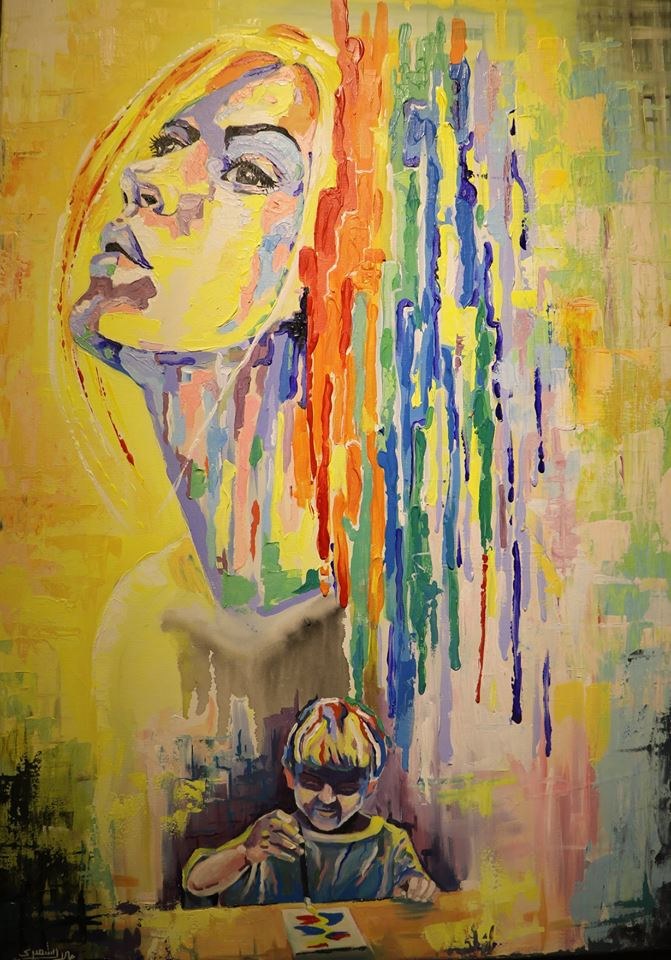
Sarah put the crayons quietly on the table in front of the boy. She opened the sketchbook and put the colours in his hand. Minutes later the little hand moved, drawing lines and curves, blood, and the mother who, once again, was scattered in front of him. An hour later, when he had finished his drawing, he looked at Sarah’s face, which was covered in tears, and spoke to her for the first time: “They did this to my mother,” he said.


Leave a Reply
Want to join the discussion?Feel free to contribute!